
|

|


Program Learning Outcomes For Biology Students
- Recognize, critique, design and carry out experiments according to the scientific method
- Synthesize and integrate abstract and practical concepts to address biological problems
- Discuss mechanisms of life at the organismal level, at the cellular level and molecular/genetic level
- Perform quantitative analyses in Biology
Biology Graduate (M.A.) and B.A./M.A. in Biotechnology
- Summarize and Articulate Advanced Research and Theoretical Concepts
- Use and Interpret Experimental Design from Current Literature in Molecular, Cellular and Developmental Biology
- Interpret Experimental Data Independently
Bio. Department News
New Doctoral Students Fall 2023
The New Biology Department Ph.D. New Students Fall 2023
New Doctoral Students Fall 2022
The New Biology Department Ph.D. New Students Fall 2022
New Doctoral Students Fall 2021
The New Biology Department Ph.D. New Students Fall 2021
New Doctoral Students Fall 2020
The New Biology Department Ph.D. New Students Fall 2020
Financial support available for:
Summer Internship, Graduate School, Post Bac. Experiences, Medical School, M.D./Ph.D. Programs, Postdoctoral Fellowships. Are you interested in a summer internship or perhaps seeking support for graduate school, medical school, an M.D./Ph.D. degree program or a postdoctoral research experience?

Hunter's Quantitative Biology Initiative
Hunter College is one of only nine institutions of higher education in the country to offer an interdisciplinary program in quantitative biology. Students majoring in Biology, Chemistry, Computer Science, Mathematics or Statistics can add a quantitative biology concentration to their major. Among the many benefits of this innovative program are access to competitive scholarships, small classes, training by a multidisciplinary team of research scientists and dedicated academics, individual mentoring, the opportunity to participate in research conducted at Hunter and nationally, topnotch preparation for graduate studies and for scientific careers in this new frontier.
To watch the QuBI Video click here
To find out more click here.
Our Department
Hunter College is located at the intersection of 68th Street and Lexington ave. in Manhattan's Upper East Side. The Biology department occupies the 8th and 9th floors of the Hunter North building. The mission of the Department of Biological Sciences parallels that of Hunter College: to provide a quality education for our undergraduate and graduate students, enabling them to participate productively in their chosen pursuits.
Teacher Evaluations
Please fill out an anonymous Teacher Evaluation for each course you take:
Computer: https://www.hunter.cuny.edu/te
Smartphone: https://www.hunter.cuny.edu/mobilete
MARC Program at Hunter
The MARC Program is Accepting Applications Now!!
Click here for instructions on how to apply
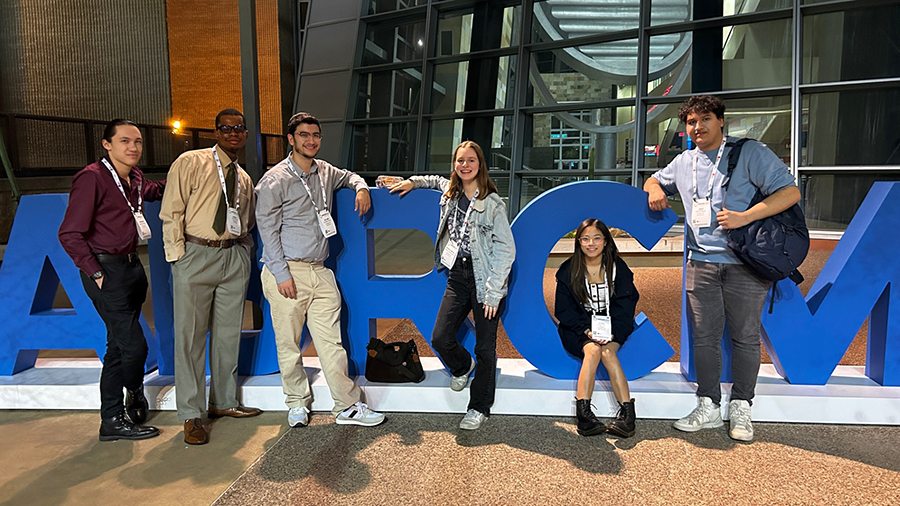
The Maximizing Access to Research Careers MARC Program at Hunter College provides year-round training for underrepresented undergraduate students at Hunter. The program’s aim is to prepare its scholars for admissions acceptance to biomedical graduate research programs.
For more information see flyer.
Bio Department Advising Schedule
Students: To talk with a faculty advisor check out the department Fall Advising Schedule -COMING SOON -
Skirball Science Learning Center
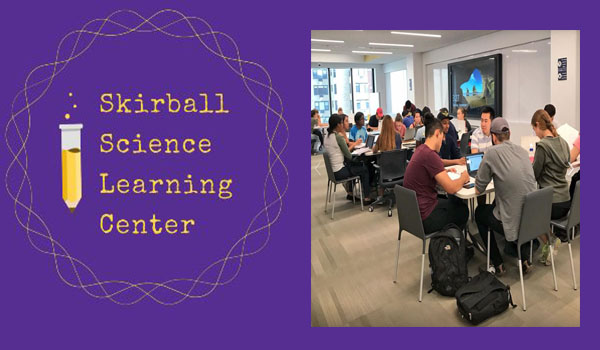
The Skirball Science Learning Center (SSLC) provides comprehensive assistance to all Hunter College students in all areas of the natural sciences and technology.
Location: 7th Floor, East Building
Phone (Desk): 212-396-6458
Director: Angela Padilla (212)-650-3707)
GENTalks: Introduction
GENTalks were designed to be a series of short recorded presentations on novel, exciting and futuristic topics in genomics, that might capture the imagination of students and scientists. These presentations were recorded by students and staff in the studio of the Department of Film and Media Studies at Hunter College. Although the COVID pandemic delayed the editing and timely release of these presentations, we are happy to begin providing this material for our community. We hope you find them stimulating and informative, and we welcome your feedback in writing.
Harvey Lodish: YouTube
Department Calendar
| No events |
Hunter RISE Program
The Minority Biomedical Research Support (MBRS) program was initiated at Hunter College in 1981 and in 2000 was changed to the Research Initiative for Scientific Enhancement (RISE) program. RISE provides underrepresented students majoring in biology, biochemistry, psychology and physics opportunities to complete research training. Students participating in the program are provided with financial, research and professional support to prepare them for Ph.D programs in biomedical sciences. The students are involved in research projects with faculty members in the biomedical research field on a year-round basis. Since its inception, the RISE program has produced approximately 75 Ph.D.’s. Currently, the program provides financial and professional development support for up to 15 undergraduates and 14 Ph.D. students.
To apply click here.
For more info here.
Scholarship Opportunity
SciMON (Science Mathematics Opportunities Network) is an innovative institutional initiative designed to enhance the extraordinary research and mentoring programs available to students who study science and mathematics at Hunter College. For more info click here
BP - Endure Program at Hunter/NYU
Scholarship Opportunity
The BP-ENDURE program is designed to encourage and prepare undergraduate students from diverse backgrounds to enter into and succeed in PhD programs in the neurosciences. The program has partnered with other institutions to enrich students’ experiences. Throughout the year, students conduct research at Hunter or NYU. During the summer, students are placed at either NYU, Brown University, University of Michigan, or Vanderbilt University. For more program and application details please visit our website, www.bpendure.org.
Application Deadline Jan 31st